

The origins of therapeutic clay
For millennia, clay has accompanied man in his quest for health and healing. The Egyptians used it for embalming and healing, the Greeks and Romans for dressing wounds and calming inflammation. In many traditional medicines, from India to Africa, it was applied as a poultice or ingested as a natural remedy. Even today, in a world saturated with chemical solutions, clay is reemerging as a valuable therapeutic resource, provided that the varieties and their properties are clearly distinguished. Because not all are equal.
Why some clays are active and others are not
Clay is not a uniform material. This name covers very different sedimentary rocks, whose composition depends on their geological origin. Some clays, such as kaolinite, are soft and soothing but have limited activity. Others, such as certain green illites, display variable and often weak properties depending on the deposit. The true effectiveness is found in smectite-type clays, of which montmorillonite is the most active representative. However, Velay bentonite is precisely a smectitic clay, rich in high-purity montmorillonite.
A unique terroir: Velay, volcanic land
Located in Haute-Loire, the Velay region is marked by its volcanic history. Ancient deposits, rich in silica and minerals, have given rise to a bentonite of rare quality. This clay combines fine grain size, homogeneity, and mineralogical purity. Its extraction, carried out in France, benefits from mastered expertise, with rigorous control of each stage: from extraction to drying, all the way to packaging. Where some clays are imported, mixed, or industrially processed, Velay clay maintains exemplary traceability and intact authenticity.
Science at the heart of its properties
Bentonite's strength lies in its layered structure, composed of two layers of silica surrounding a layer of alumina. This arrangement creates an interlayer space capable of retaining or exchanging ions. Its cation exchange capacity (CEC), which measures this power, reaches remarkable values of 80 to 150 meq/100 g, compared to only 10 to 30 for illitic clay. This means that Velay clay is not a simple inert powder: it actively interacts with its environment, capturing excess water, binding toxins, and releasing minerals useful to tissues.
Silica, present in high proportions, stimulates collagen synthesis and promotes healing. Alumina helps soothe irritated tissues. Magnesium supports muscle relaxation and enzymatic reactions, while calcium and potassium participate in remineralization and proper cellular function. Even iron oxides, although in small quantities, play a role in microcirculation and local oxygenation.
Multiple mechanisms of action
Three main effects explain its effectiveness:
-
Adsorption : Clay binds bacteria, toxins, and heavy metals to its surface. It acts as a natural filter, cleaning the area of application.
-
The osmotic effect : when drying, the clay attracts excess liquids (serous fluids, pus, edema) and drains the inflammation outwards.
-
Ion exchange : The sheets release ions such as calcium and magnesium, which support tissue repair and cell regeneration.
This trio explains why a simple Velay clay poultice can reduce inflammation, accelerate healing and soothe irritation, whereas other clays only provide a superficial soothing effect.
Veterinary applications: from horse to dog
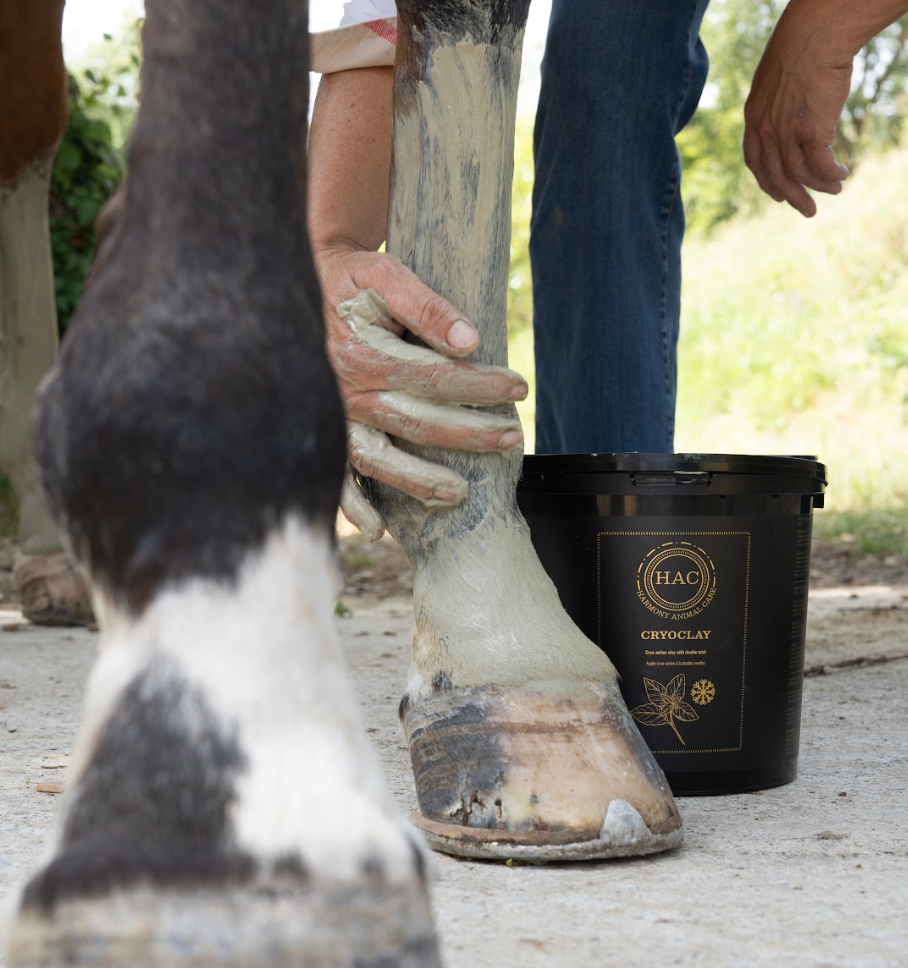
In horses, Velay clay is particularly recommended after exercise. Applied to tendons or joints, it reduces swelling, limits inflammation, and promotes rapid recovery. Top-level riders use it to maintain performance and prevent injuries.
In dogs and cats, this clay is valuable for soothing itching, treating small wounds, calming overheated pads, and treating skin irritations. In livestock farming, it also finds its place as a natural solution for managing minor trauma or skin conditions, thus limiting the systematic use of chemical products.
A clear difference from other clays
Comparing Velay bentonite to other clays reveals a considerable difference. White kaolins, widely used in cosmetics, are soft but virtually inert. Green illites, widely marketed, have variable activity depending on their source, sometimes weak, sometimes nonexistent. Velay bentonite, on the other hand, combines purity, richness in montmorillonite, and reproducible effectiveness. It is rarer and more expensive, but its results are incomparable.
French production, a guarantee of quality
The other major advantage of this clay lies in its origin and processing. Produced in France, at a single site, it is extracted, dried, and ground using mechanical processes that respect the material. No additives, no blends: only the whole Velay clay. Each batch is laboratory-tested to ensure the absence of chemical or bacterial contaminants. This rigor makes it an international standard, used in both human medicine and veterinary care.
Harmony Animal Care's Choice
At Harmony Animal Care, we took the time to research and compare. We found that many brands used common clays, chosen for their low cost rather than their effectiveness. Some are so low in montmorillonite that they provide no real benefit to the animal. We rejected this easy option.
We chose Velay clay because it's the best. Because it's produced in France, in compliance with standards and respect for nature. Because its composition and properties make it a truly active clay, not just a marketing ploy. Yes, it's more expensive, but it's also infinitely more effective. And above all, it reflects our belief: animals deserve the best.
Conclusion
Velay bentonite is unlike any other clay. It combines the power of geology, the precision of science, and the wisdom of tradition. Its action is measurable, reproducible, and tangible. By choosing it, Harmony Animal Care affirms a clear commitment: to offer animals uncompromising quality, worthy of their importance in our lives.